Email security · Enterprise SaaS
Email Threat Prevention
Helping organizations detect, investigate, and manage advanced email threats.

- Company
- FireEye (now Trellix)
- Role
- Senior Staff UX Designer
- Period
- March 2014 – June 2018
Over four generations, the portal went from a place to watch threats to a place where administrators run email security on their own.
Overview
FireEye Email Threat Prevention Cloud (ETP Cloud) protects organizations from sophisticated email-based cyberattacks that traditional signature-based security solutions may not detect.
As the sole product designer, I owned the end-to-end product experience from MVP through four generations of the product, working closely with the product owner and engineering teams.
The objective was to simplify email security management and enable administrators to detect threats, investigate malicious emails, manage security policies, and provision domains through a unified portal.
The Challenge
Managing email security involves complex threat data, multiple domains, security policies, and operational workflows.
Email administrators and support teams faced several challenges:
- Dependency on backend operations for domain provisioning.
- Manual replication of security policies across multiple domains.
- Limited visibility into email threats and attack patterns.
- Complex workflows for investigating and managing quarantined emails.
- Different information and access requirements across user roles.
Showing threat data was not enough. Administrators needed to understand a threat, act on it, and run their own setup without calling the backend team.
Design Approach
I started by understanding the workflows, responsibilities, and pain points of email administrators and support teams through user interviews and stakeholder discussions.
The design approach focused on four areas:
- Prioritize information: Present critical security insights upfront, with access to detailed information for deeper investigation.
- Simplify security operations: Reduce manual steps across threat investigation, quarantine management, and domain provisioning.
- Enable self-service: Reduce dependency on backend operations by bringing administrative capabilities into the portal.
- Design for scale: Establish a flexible policy and domain management model that supports growing enterprise environments.
The designs evolved through multiple iterations, wireframes, and prototypes, with continuous feedback from the product owner and engineering teams.
Product Evolution
As the sole product designer, I designed the complete product experience from MVP through its fourth generation.
As the product evolved, the focus expanded from providing visibility into email threats to enabling administrators to independently manage security operations, policies, and domains.
Each generation introduced new capabilities while maintaining a consistent and scalable product experience.
Final Design
The product experience was organized around four core areas: security monitoring, threat investigation, policy management, and domain provisioning.
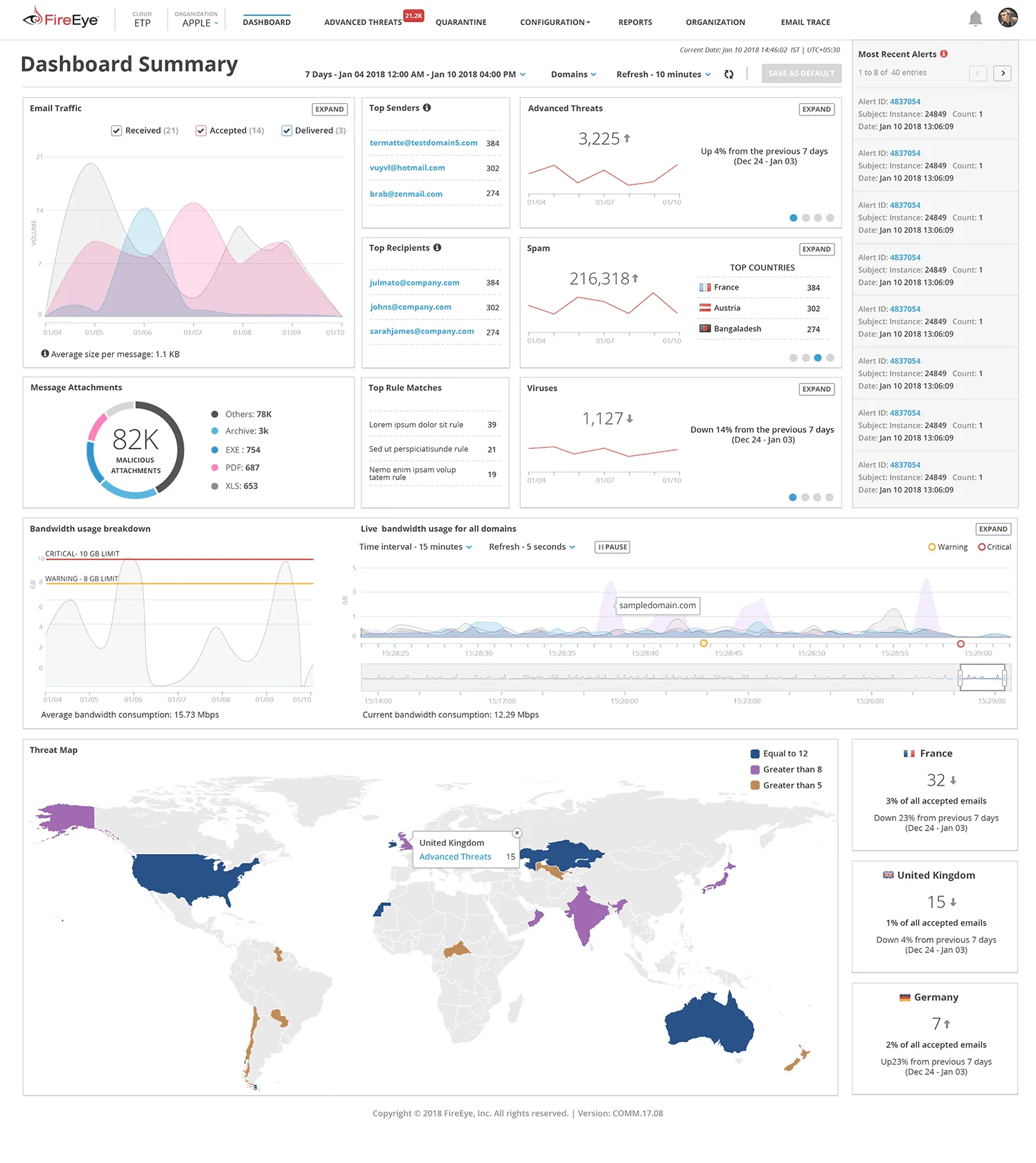
Dashboard
Designed a centralized view of email security that helps administrators understand the overall security posture of their organization.
The dashboard provides visibility into:
- Email traffic and acceptance rates.
- Threat activity and trends over time.
- Recent malicious email attacks.
- System status and operational information.
The information hierarchy was designed to help administrators quickly understand what requires attention before exploring detailed security data.
Advanced Threats
Designed a dedicated investigation workspace for identifying, analyzing, and managing malicious emails.
Administrators can search and filter threats across domains, review quarantine status, investigate individual emails, and take appropriate actions such as releasing or deleting quarantined messages.
The experience brings threat information, investigation, and response actions together, reducing the need to navigate between separate workflows.
Policies
One of the key challenges was the dependency between security policies and individual domains. Administrators had to recreate similar policies across multiple domains, introducing unnecessary effort and maintenance complexity.
I redesigned the underlying interaction model by separating policy management from domain configuration.
This enabled administrators to:
- Create and manage reusable security policies.
- Associate policies with multiple domains.
- Modify policy associations without affecting unrelated domains.
- Manage security configurations independently of domain provisioning.
This approach established a more scalable policy management model for organizations managing multiple domains.
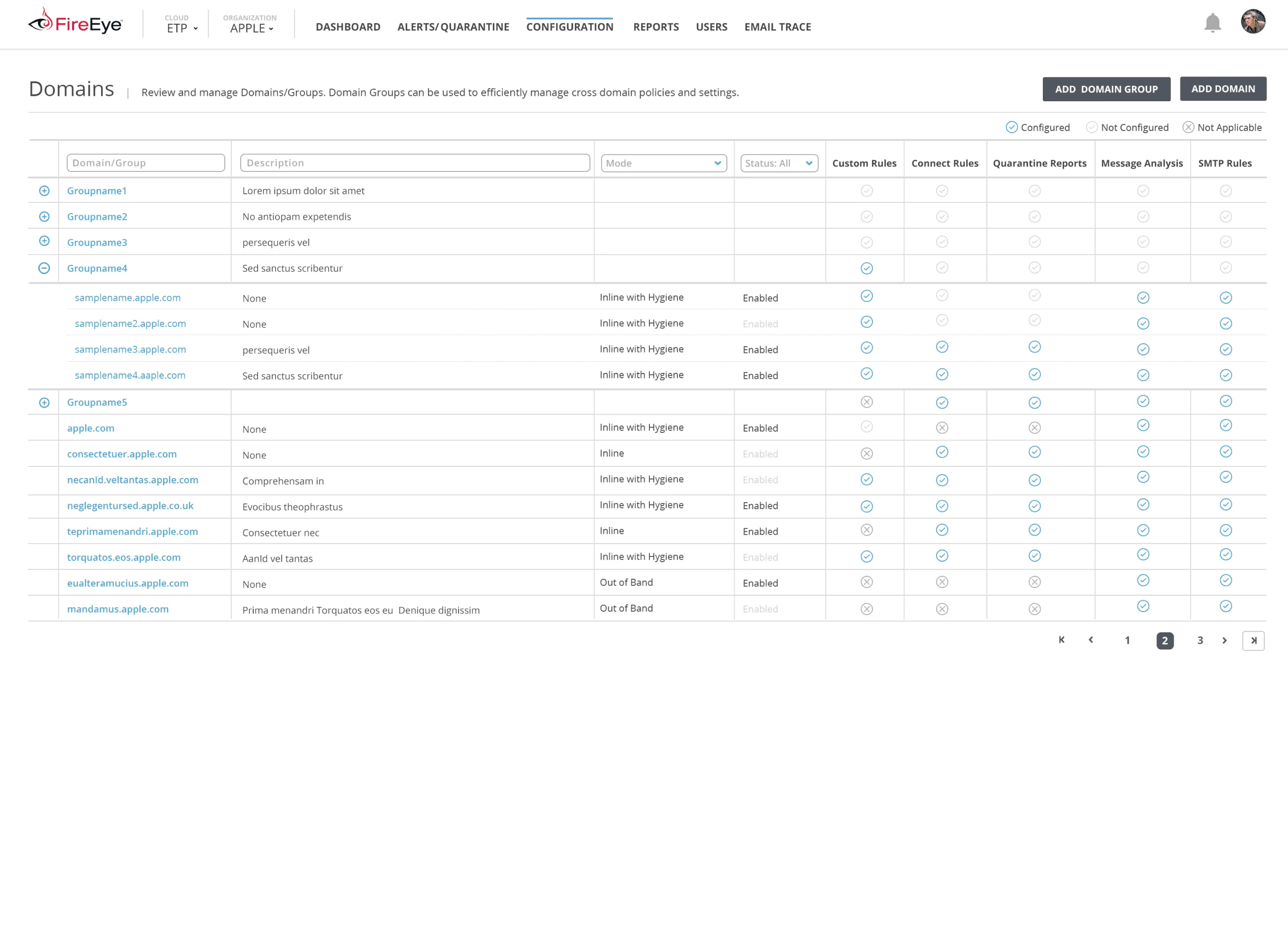
Domain provisioning
Domain provisioning previously required backend intervention, creating additional operational dependencies.
I designed a self-service provisioning experience that brought domain management directly into the portal.
Administrators could provision domains, manage domain groups, and understand the relationships between domains and their associated security policies.
The experience was designed to reduce operational dependencies while providing administrators with greater visibility and control.
Design Impact
The product evolved from a threat monitoring portal into a more comprehensive, self-service email security management platform.
- Simplified threat investigation and quarantine management workflows.
- Improved visibility into email security and attack patterns.
- Reduced dependency on backend operations for domain provisioning.
- Eliminated the need to recreate security policies across individual domains.
- Established a scalable management model for enterprise environments.
- Maintained a consistent product experience across four generations of the product.
Over four generations, the portal went from a place to watch threats to a place where administrators run email security on their own.