DevOps · Service reliability
Service Reliability Management
Helping engineering teams deliver software faster without compromising service reliability.

- Company
- Harness
- Role
- Principal UX Designer
- Period
- September 2021 – February 2024
Reliability stopped being something teams looked at after an incident. It became a step in how they ship.
Overview
Harness Service Reliability Management (SRM) helps developers, DevOps engineers, and Site Reliability Engineers (SREs) balance software delivery velocity with production reliability.
As the Principal Product Designer, my focus was on simplifying complex reliability concepts such as Service Level Objectives (SLOs), error budgets, and deployment impact, making them accessible and actionable for engineering teams.
The objective was to make reliability an integral part of the software delivery lifecycle rather than an activity performed after incidents occur.
Challenges
Service reliability involves large volumes of data, complex metrics, and dependencies across services and deployments.
Engineering teams faced several challenges:
- Developers often prioritized feature delivery over service reliability.
- Limited visibility into SLO performance and error budget consumption.
- Complex metrics that were difficult to interpret and act upon.
- Reliance on SREs to identify issues and initiate corrective actions.
- Lack of automated reliability guardrails within software delivery pipelines.
Charts alone would not fix this. Teams needed to know if a service was healthy, find out why when it wasn't, and decide if it was safe to deploy
Design Approach
I started with what developers, DevOps engineers and SREs each needed. Google's SRE handbook gave me the basics of how reliability is practised.
Through discussions with stakeholders and the Harness SRE community, I focused the design around four areas:
- Simplify complexity: Translate technical reliability concepts into meaningful and actionable information.
- Prioritize information: Establish a clear information hierarchy that helps users understand service health before exploring detailed metrics.
- Enable proactive decisions: Make SLO performance and error budget consumption visible throughout the software delivery lifecycle.
- Integrate reliability into delivery: Introduce automated reliability checks and guardrails within existing deployment workflows.
The intent was to move from passive monitoring towards proactive reliability management.
Design Explorations
I explored multiple ways to present service health, SLO performance, error budgets, and deployment impact.
Rather than presenting all available metrics at once, I focused on the questions engineering teams need to answer:
- Is my service healthy?
- Are we meeting our reliability objectives?
- How much error budget do we have remaining?
- What changes are affecting service reliability?
- Is it safe to continue deploying?
These questions helped define the information hierarchy, data visualizations, and investigation workflows.
The concepts evolved through multiple iterations and feedback from stakeholders, SREs, and engineering teams.
Ideations for Monitored Service details
Final Design
The final experience brought service health, reliability objectives, deployment impact, and investigation workflows together within a connected experience.
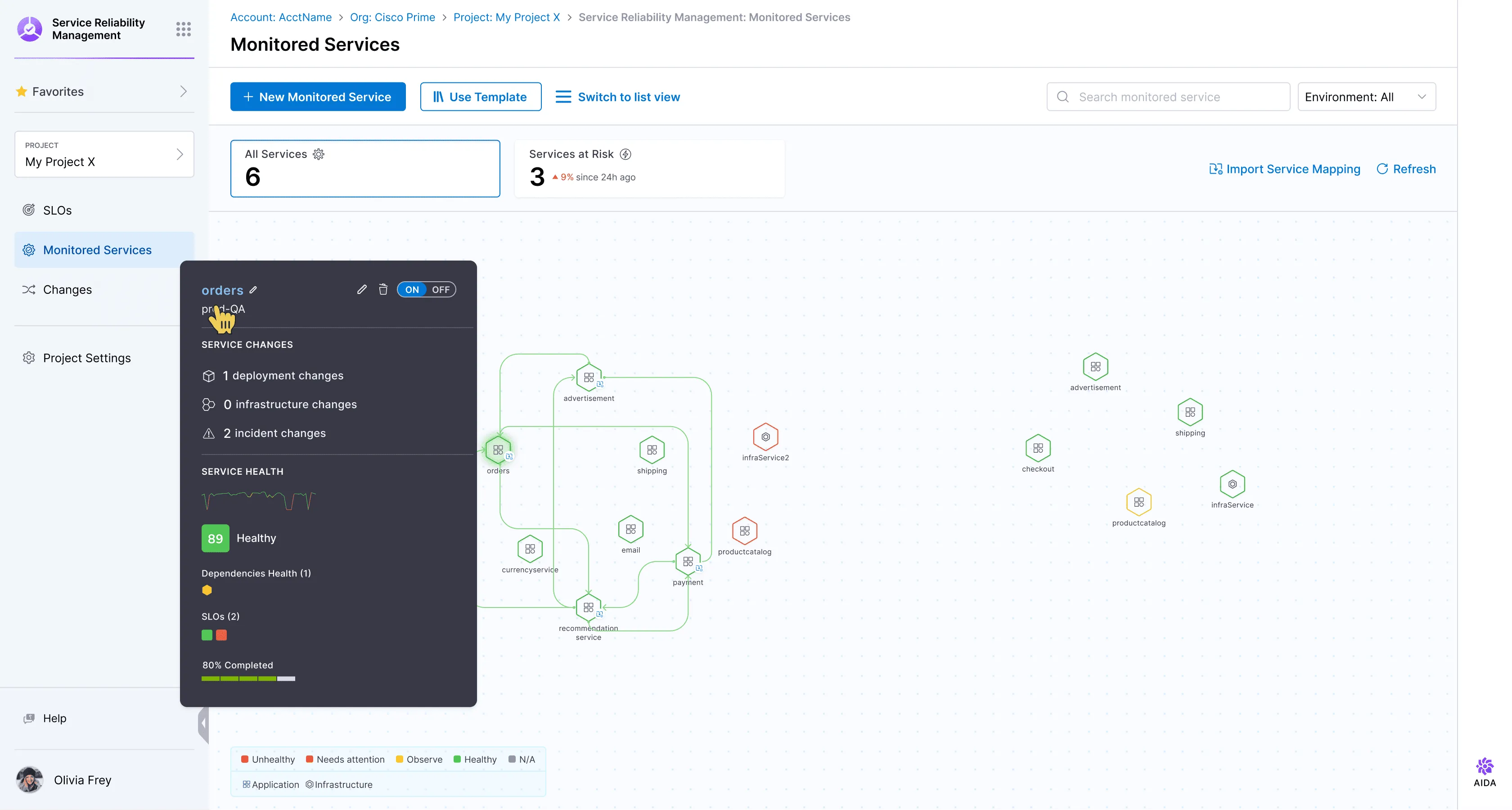
Monitored Services
Designed a unified view of service health that helps engineering teams understand the current state of their services, identify reliability risks, and investigate contributing factors.
The experience progressively reveals information, starting with service-level health and providing access to detailed metrics when further investigation is required.
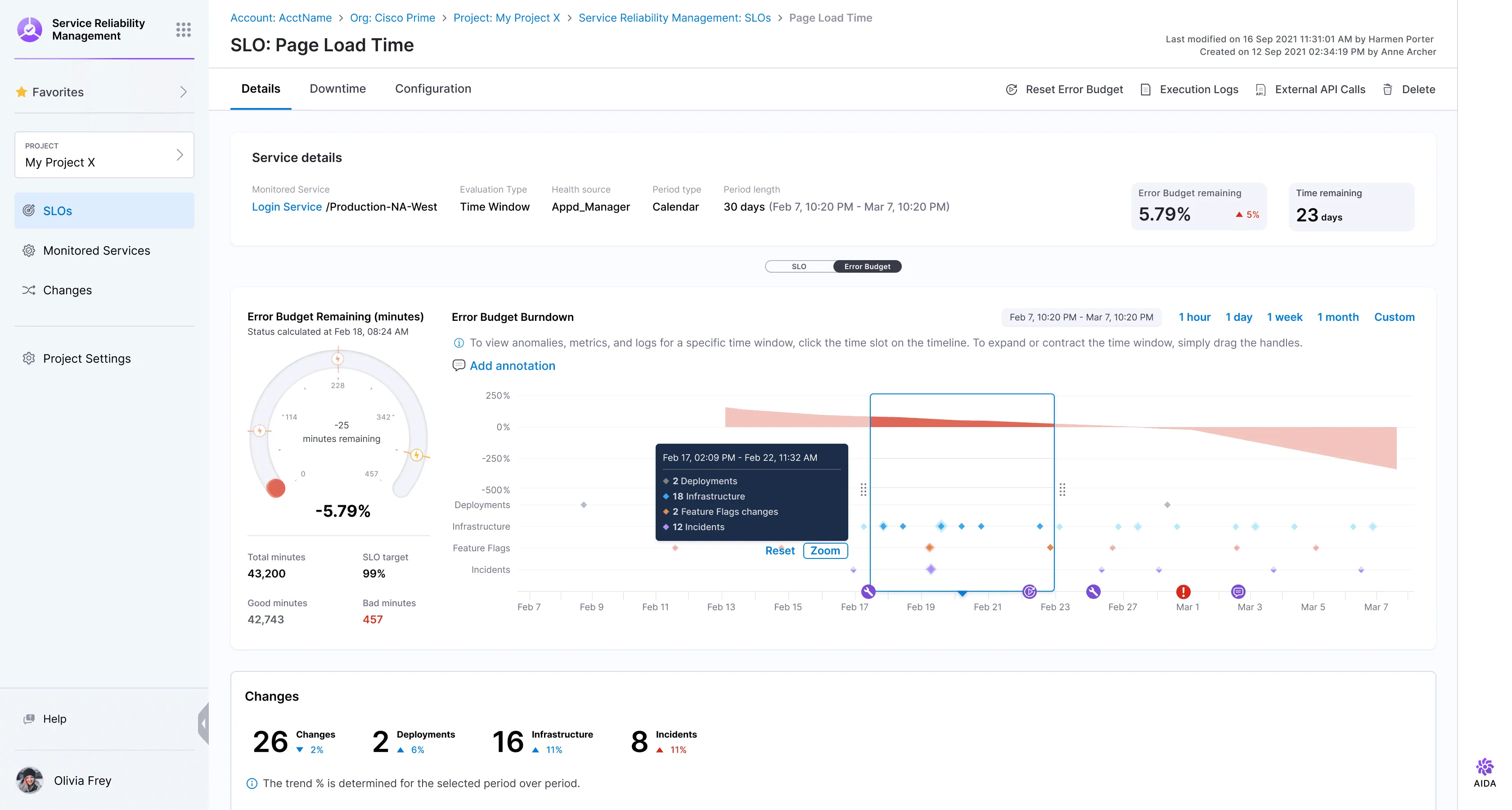
Service Level Objectives
Designed an experience that simplifies the creation, monitoring, and investigation of SLOs and error budgets.
Engineering teams can understand how reliability is affected by deployments, infrastructure changes, feature flags, chaos experiments, and incidents.
The focus was on connecting reliability metrics with the events that influence them, helping users understand not just what changed, but what may have contributed to the change.
Deployment Impact Analysis
Designed a reliability verification experience within the software delivery pipeline.
The pipeline checks metrics and logs after each deployment, using machine learning to spot changes in service health. Teams see the risk before users do.
This brings reliability checks into the deployment workflow, reducing the dependency on manual verification and post-deployment investigation.
Design Impact
The SRM experience brought reliability monitoring, investigation, and software delivery into a connected workflow.
- Made complex reliability concepts easier to understand and act upon.
- Improved visibility into service health, SLO performance, and error budget consumption.
- Connected reliability metrics with deployments and operational changes.
- Enabled more proactive investigation and decision-making.
- Established a foundation for automated reliability management within software delivery pipelines.
Reliability stopped being something teams looked at after an incident. It became a step in how they ship.